
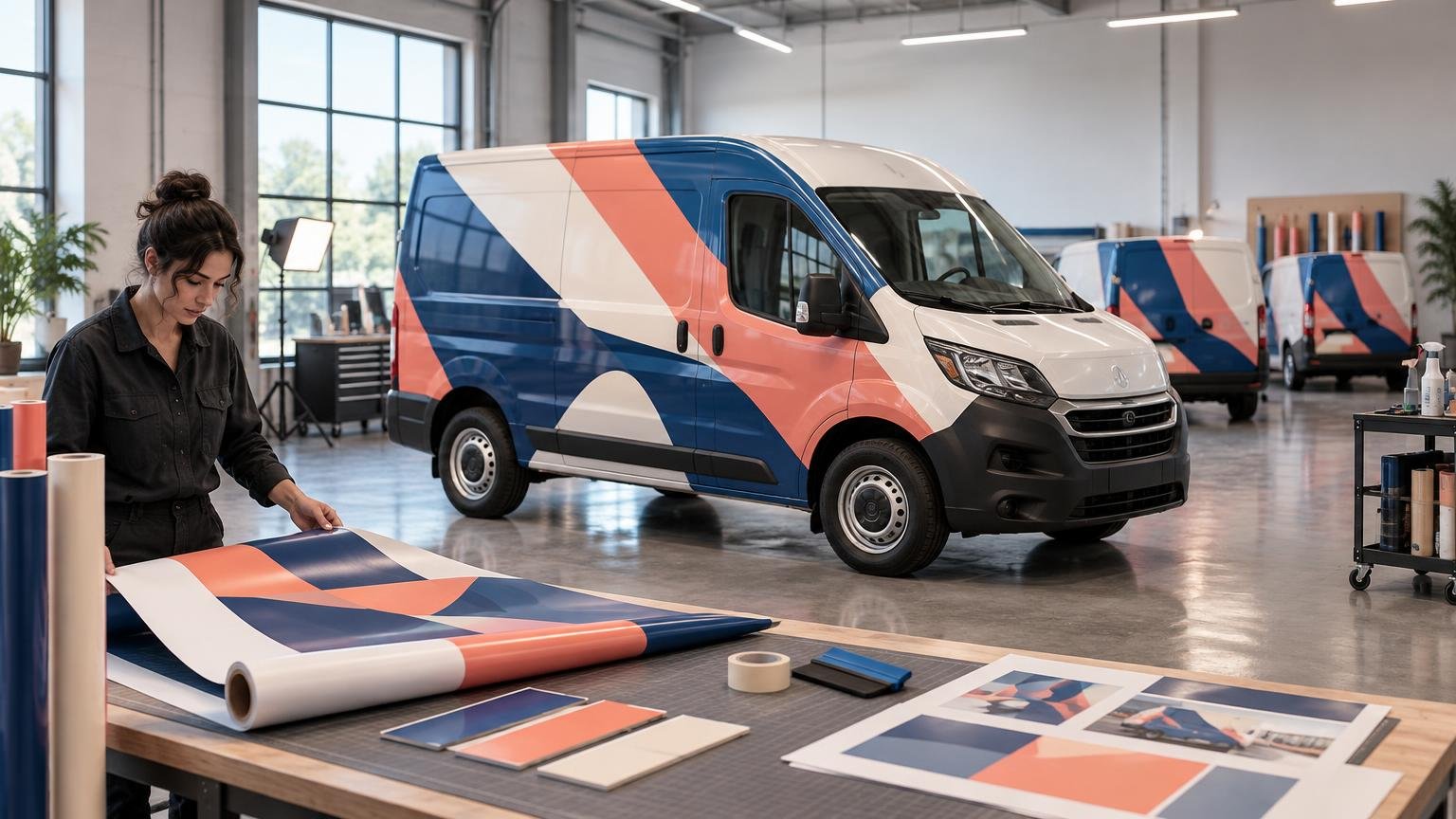
TLDR: A fleet wrap marketing campaign works best as a managed media system, not a one-time vehicle decoration project. Set one campaign objective, reduce the design to a message readable in motion, prioritize vehicles by route and visibility, approve a prototype before fleet-wide production, and create records for installation, photography, maintenance, replacement, and attribution. Treat phone numbers, URLs, QR codes, and tracking conventions as campaign infrastructure rather than last-minute additions.
The creative challenge is not filling every door and panel. It is deciding what a person should understand after seeing the vehicle for only a few seconds. The operational challenge is making that message consistent across different body styles without taking the entire fleet out of service. A strong fleet wrap marketing campaign solves both problems before the first graphic is printed.
Start the fleet wrap marketing campaign with one objective
Decide what the fleet is supposed to accomplish. Common objectives include building recognition in a service area, introducing a new service, supporting recruitment, promoting a seasonal offer, or generating inquiries. Those goals demand different messages and response paths.
A recognition campaign can emphasize the company name, category and visual identity. A lead-generation campaign needs a clearer action, such as calling a memorable number or visiting a short landing-page URL. A hiring campaign may require a dedicated careers destination rather than sending people to the company homepage.
Write a one-sentence campaign brief before design begins: “People in this service area should recognize us as the company for this service and know how to take this action.” If the brief contains several audiences, offers and actions, narrow it. A moving vehicle cannot carry the informational burden of a brochure.
Build a message hierarchy for a moving vehicle
A practical hierarchy usually has four layers: the company name, what the company does, a geographic cue when location matters, and one primary response path. The logo is not automatically the first layer. If the logo does not explain the category, the service description may need equal or greater visual weight.
- Name the company or brand clearly.
- State the service in plain language rather than relying on an abstract slogan.
- Add a service-area cue only when it helps qualify the audience.
- Choose one primary action: call, visit or remember the brand.
- Keep supporting details subordinate and remove anything that competes with the main message.
Evaluate the design at realistic viewing conditions. Zooming into artwork on a large monitor encourages small type, fine detail and too many claims. Instead, review side, rear and three-quarter mockups at reduced scale. Ask a colleague unfamiliar with the project what they notice first and what they believe the company does.
Give the rear layout special attention. A rear-facing viewer may have more time to read it than someone crossing the vehicle’s side, but the rear also contains door seams, handles, windows, lights and license-plate areas. The composition must work around the vehicle rather than pretending it is a flat rectangle.
Prioritize vehicles, routes and parking locations
Do not automatically wrap vehicles in purchase order or alphabetical order. Start with the units that provide the best combination of reliable availability, useful panel space, relevant routes and visible parking. A vehicle that spends most of its day inside a depot plays a different media role from one that travels and parks throughout the target service area.
Create a fleet inventory containing the year, make, model, body configuration, identification number, usual route, overnight location, expected replacement date, current body condition and operational constraints. Vehicle type, dimensions, fleet size, coverage, brand standards and budget are among the planning factors identified in 3M’s fleet graphics guidance. The same guidance distinguishes full wraps, partial wraps, decals and reflective treatments and recommends reviewing proofs or prototypes before broad production.
| Vehicle or format | Potential campaign role | Production consideration |
|---|---|---|
| Cargo van | Large, continuous brand presentation | Account for handles, rails, contours and door operation |
| Pickup truck | Local service visibility with flexible branding | Coordinate cab, bed and tailgate as separate surfaces |
| Box truck or trailer | High-impact message with broad panels | Design for long viewing distances and large seams |
| Passenger car | Light-duty brand recognition | Use restraint because usable panel space is limited |
| Temporary or replacement decal | Short-term information or a localized update | Match color, scale and placement to the main graphics system |
Fleet graphics do not have to use identical compositions on every body style. They should use the same visual system: consistent colors, typography, message order, image treatment and response path. Adaptation preserves consistency better than stretching one master layout across incompatible vehicles.
Choose coverage based on the campaign and replacement cycle
Full wraps can create a dramatic transformation and broad visual continuity. Partial wraps can concentrate color and imagery on the most useful surfaces while leaving some vehicle paint visible. Cut graphics or decals can suit simpler identification, smaller budgets, temporary additions or vehicles nearing replacement. Reflective elements can add visibility in certain conditions, but material choice, placement and compliance need professional review.
Consider lifecycle cost, not just the initial quote. A design with several vehicle-specific panels may cost more to manage when collision repair, door replacement or updated contact details require reprints. Ask the producer how artwork will be divided into panels, how replacements will be color-managed and what production records will be retained.
Keep temporary promotions separate from durable brand graphics where practical. Removable campaign decals can prevent a short-lived offer from becoming embedded in the primary wrap. For small supplemental graphics on equipment, handoff materials or non-wrap applications, custom stickers and decals may provide a more flexible production path than revising a complete vehicle graphic.
Give phone numbers, URLs and QR codes distinct jobs
A phone number is useful when calls are central to sales and the number can be read and remembered. A short URL can serve people who notice the brand and respond later. A QR code is better treated as a parked-vehicle interaction than as the only response path; drivers should not be expected or encouraged to scan moving vehicles.
Send the QR code and short URL to a mobile-friendly destination that matches the campaign. That might be a quote form, service-area page, careers page, appointment page or concise offer page. Do not send every campaign to a generic homepage if visitors must then search for the promised next step.
Test the final QR code from printed output rather than relying only on a digital proof. Test it on the intended surface, from several reasonable distances, under different lighting and with more than one phone. Preserve enough clear space around the code, and avoid placing it across a door seam, handle or severe curve.
Approve one vehicle before rolling out the fleet
Use a proofing sequence that moves from concept to vehicle-specific execution. Approve the message and visual system first, then panel maps and scaled mockups, followed by production artwork. For a mixed or large fleet, a prototype vehicle can expose problems that remain invisible in a flat proof.
- Inspect and photograph the vehicle before production.
- Confirm its exact year, make, model, body configuration and aftermarket equipment.
- Map panel edges, windows, handles, lights, sensors, trim and damaged areas.
- Review spelling, numbers, URLs, QR destinations and service-area language.
- Approve color references and identify which colors are expected to match across print and digital assets.
- Produce and inspect a representative vehicle before authorizing the remaining fleet.
- Record approved files, revisions, material details and installation dates.
Vehicle condition and preparation affect execution. 3M’s application guidance warns that work around contours and recesses can develop wrinkles or lifting when application is not handled correctly. That makes inspection, cleaning, surface preparation and installer technique part of the production plan rather than administrative details.
Schedule installation in operational waves
Installation time is not universal. It varies with preparation, vehicle size, coverage, surface complexity and installer experience. Ask prospective providers for a schedule based on the actual fleet roster and approved coverage rather than a generic per-vehicle promise.
Divide the rollout into waves so the business retains enough vehicles for normal operations. Start with a small representative group, inspect the completed work, document any adjustments and then release the next group. Include cleaning, delivery, installation, curing or post-install instructions, inspection and return-to-service handoff in the schedule.
Coordinate the rollout through the broader campaign calendar. The vehicle launch may need to align with landing pages, call routing, sales scripts, social content and local promotions; a campaign calendar for milestones and dependencies helps prevent the physical media from launching before its response system is ready.
Photograph and document the finished fleet
Treat completion photography as a campaign asset, not merely proof that installation occurred. Capture both sides, the front, rear, three-quarter views and details of important graphics. Add in-context images at a real operating location when permission and safety allow. Keep the vehicle clean, remove unrelated clutter and avoid backgrounds that obscure the silhouette.
Use a repeatable shot list for every vehicle. Consistent framing makes it easier to compare installations, document damage, create sales materials and update the image library when vehicles enter or leave the fleet. Record the unit identifier and photography date with each set.
Plan maintenance and replacement before damage occurs
Create a graphic record for every vehicle. It should connect the vehicle identifier to approved artwork, source files, print-ready exports, fonts or outlined typography, color references, panel maps, material documentation, installer, installation date, photographs and later repairs.
Define who reports damage and who approves a replacement panel. Collision repair, body-panel replacement, peeling edges and changes to phone numbers or service areas should follow a documented path. Without that process, a fleet gradually becomes a collection of mismatched revisions.
Field-branding systems may also include equipment labels, inspection information or service reminders. Keep those functional pieces distinct from promotional graphics, especially when they carry regulated or operational information. The same distinction matters in broader field branding and service-label workflows.
Measure response without inventing an ROI story
Fleet graphics can contribute to recognition and response, but a wrap alone does not reveal how many people noticed it or what caused every later conversion. Build measurable response paths where practical, then evaluate them alongside route, timing and other campaign activity.
Use a dedicated landing page or memorable short URL, campaign-specific call-routing documentation and a CRM campaign field. Add UTM parameters to the destination behind a QR code or trackable redirect. Google’s guidance explains the use of parameters including utm_source, utm_medium and utm_campaign, and notes that capitalization differences create separate reporting values. Establish one naming convention before launch. Google Analytics’ campaign URL guidance
- Record scans, tracked visits, calls and form submissions tied to the campaign path.
- Ask new leads how they heard about the company, while recognizing that recall is imperfect.
- Tag qualified opportunities and completed sales in the CRM rather than stopping at visits or calls.
- Compare results by time period, route group or rollout wave when the data volume makes that useful.
- Review changes in branded search and direct traffic cautiously because other marketing can influence both.
- Document URL redirects and call-routing ownership so tracking does not break during staff or platform changes.
Include a compliance checkpoint
Do not treat every visible surface as printable inventory. Preserve required lights, reflective devices, plates, driver-view windows, sensors and legally required markings. Federal rules prescribe lamps and reflective devices by vehicle type and location, so required equipment cannot simply be covered or visually absorbed into a design. Review the federal lamp and reflective-device rule and confirm all vehicle- and jurisdiction-specific requirements with qualified compliance and installation contacts.
This review should happen during panel mapping, not after printing. Fleet operators should also check applicable state and local requirements, lease conditions, manufacturer limitations and any industry-specific vehicle markings.
Production handoff checklist
- One documented campaign objective and primary audience
- Fleet inventory with routes, body styles, condition and replacement timing
- Approved message hierarchy and channel-specific call to action
- Vehicle-specific templates, panel maps and final proofs
- Verified phone routing, URL ownership, QR destination and UTM naming
- Prototype approval or first-vehicle inspection
- Phased installation schedule that protects fleet capacity
- Compliance review for lights, reflectors, windows, plates and required markings
- Final artwork archive, production specifications and replacement process
- Consistent launch photography and vehicle records
- CRM fields, reporting ownership and a scheduled performance review
Turn the fleet into a managed channel
The best next step is not requesting a wrap quote from a logo file. Build the campaign brief and fleet inventory first, then ask providers to respond to the same vehicle list, coverage strategy, proofing requirements, installation waves and replacement expectations.
That approach makes creative quality, production scope and operational impact easier to compare. More importantly, it turns fleet graphics into a repeatable local media channel: one with a clear message, controlled rollout, maintained assets and a response system the business can actually review.