
TLDR
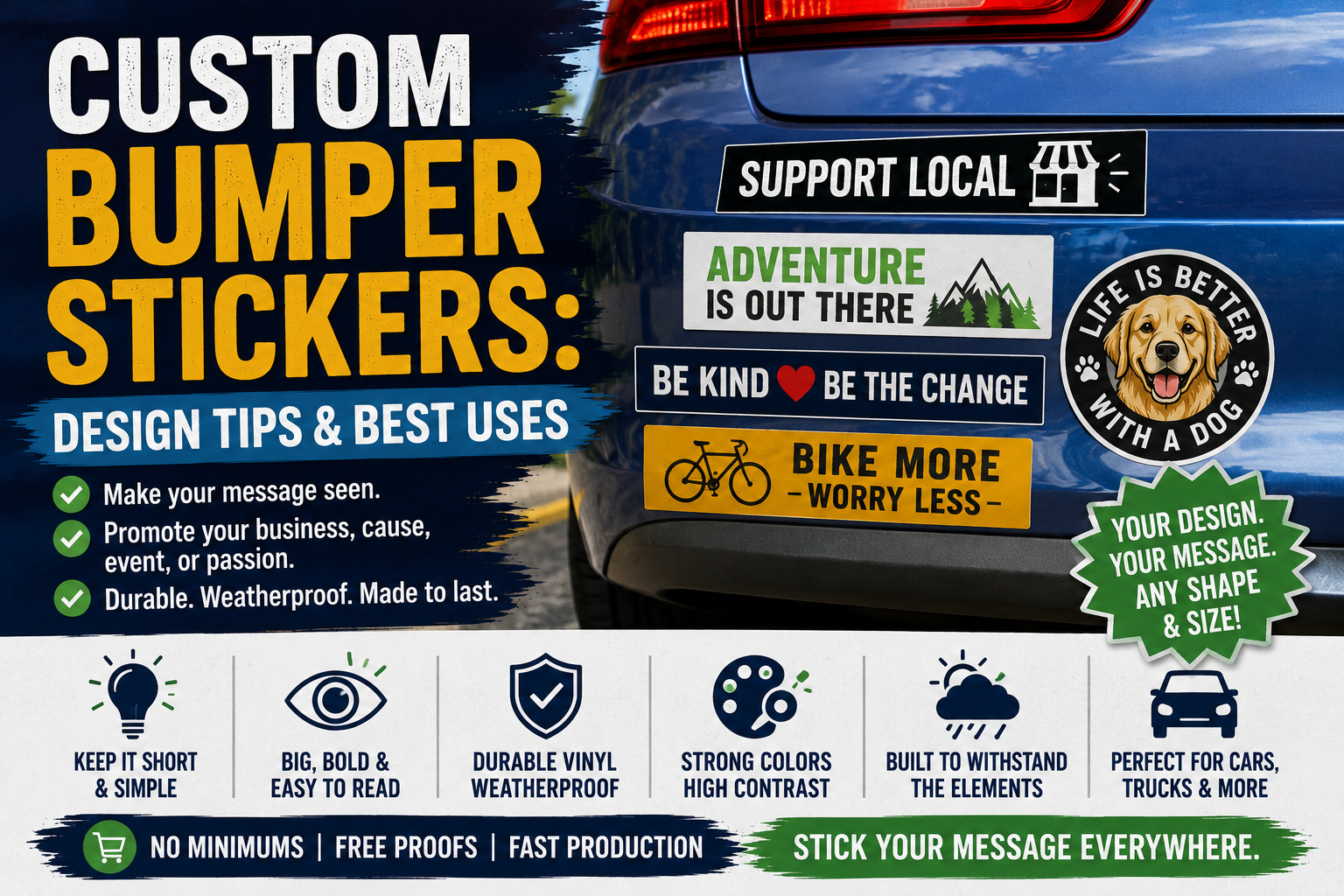
Custom bumper stickers work best when they communicate one idea quickly.
- Keep the main message short.
- Use large, bold type.
- Choose strong color contrast.
- Design for viewing from several feet away.
- Use laminated outdoor vinyl rather than paper.
- Keep important text away from the edges.
- Apply stickers only to clean, dry, smooth surfaces.
- Choose a classic rectangle for messages or a custom shape for logos and artwork.
Bumper stickers are useful for business advertising, community groups, campaigns, schools, bands, events, clubs, giveaways, and personal messages.
A good bumper sticker gets only a few seconds of attention. Someone may see it in traffic, walk past it in a parking lot, or notice it on a toolbox across a jobsite. There usually is not enough time to study a complicated illustration or read a full paragraph.
That is why custom bumper stickers need a different design approach than laptop stickers, package seals, or product labels. The message must be short. The lettering must be large. And the material has to handle sunlight, rain, road grime, temperature changes, and regular washing.
Here is how to create a bumper sticker that remains clear, useful, and easy to remember.
What Are Custom Bumper Stickers?
Custom bumper stickers are durable adhesive graphics designed for vehicles and other outdoor surfaces. They are traditionally long rectangles, but they can also be cut into circles, badges, mascots, logos, and other custom shapes.
They are commonly used on:
- Car bumpers
- Tailgates
- Vehicle windows
- Trailers
- Toolboxes
- Hard-sided coolers
- Equipment cases
- Store windows
- Outdoor signs
YouStickers prints custom bumper stickers on outdoor vinyl with a protective laminate. Customers can choose matte or gloss finishes, standard rectangles, or custom die-cut shapes. The product page also lists car-safe adhesive intended to hold during outdoor use while allowing clean removal when the message needs to change.
The finished sticker can carry a slogan, logo, illustration, website, campaign message, business name, or local reference. But it should still focus on one main idea.
Keep the Bumper Sticker Message Short
A bumper sticker is not a small brochure.
The reader may be moving. The vehicle may be moving. Sometimes both are moving, which is not the ideal setting for a thoughtful paragraph about your organization’s history.
Try to keep the primary message under eight words when possible. Shorter is often better.
Strong bumper sticker messages include:
- A short business name
- A memorable slogan
- A cause or campaign phrase
- A local joke
- A club name
- A team message
- A simple call to action
- A short website address
Compare these two examples:
Johnson County Residential and Commercial Landscaping Services
Cleaner Yards. Happier Weekends.
The first explains more, but it is difficult to read quickly. The second gives people an idea they may remember. A logo or short web address can provide the remaining context.
Before designing, write the message in plain text. Remove words until every remaining word earns its place.
Design for Distance, Not for Your Computer Screen
A bumper sticker may look clear while it fills a 27-inch monitor. That does not mean it will remain readable when printed at 10 inches wide and viewed from across a parking lot.
Large letters matter more than tiny decorative details. Bold typefaces usually perform better than thin scripts, condensed fonts, or highly ornamental lettering.
Canva’s bumper sticker guidance recommends simple messages, easy-to-read fonts, bright colors, and shapes that support quick recognition.
A useful test is to print the design at its actual size on ordinary paper. Tape it to a wall and step back 20 to 30 feet.
Ask:
- Can you read the main message immediately?
- Is the business name clear?
- Does one element stand out first?
- Are secondary details still necessary?
- Do any letters blend into the background?
When the sticker does not pass the distance test, make the type larger or remove information.
Use Strong Color Contrast
Contrast helps a bumper sticker remain readable through glare, shade, rain, dust, and changing light.
Reliable combinations include:
- Black and white
- Dark blue and white
- Yellow and black
- White and red
- Cream and dark green
- Bright orange and navy
Low-contrast combinations can look tasteful on a screen but disappear on the road. Light gray text over pale blue may be attractive on a website. It is not especially useful on a moving truck.
Brand colors can still work. But they may need support.
You can improve visibility by adding:
- A white outline
- A dark stroke around letters
- A solid background panel
- A border around the full sticker
- A simplified version of the logo
- A higher-contrast secondary color
Think about the vehicle color too. A black sticker may disappear on a black bumper. A white design can blend into a white tailgate. A visible border helps the same bumper sticker work across more vehicle colors.
Choose the Right Bumper Sticker Size
There is no official universal bumper sticker size, but the traditional format is around 3 inches tall and 11 to 11.5 inches wide. That long shape fits many bumpers and provides enough horizontal room for a short message.
Common bumper sticker sizes include:
| Size | Best Use |
|---|---|
| 8″ × 3.5″ | Short slogans and compact vehicle areas |
| 10″ × 3″ | Classic bumper sticker messages |
| 11.5″ × 3″ | Longer slogans and business names |
| 12″ × 3.5″ | Events, campaigns, and larger logos |
| 14″ × 4″ | High-visibility messages and commercial vehicles |
| Custom size | Mascots, badges, logos, and unusual layouts |
YouStickers supports classic horizontal formats as well as custom sizes and custom die-cut bumper stickers.
Choose the size based on the artwork and installation area. Do not stretch a short logo across a long rectangle just because that is the traditional shape.
And measure the vehicle before ordering. Bumpers may contain sensors, trim, curves, recessed areas, tow hooks, and textured panels that reduce the usable space.
Choose a Shape That Supports the Design
Rectangular bumper stickers are practical because they provide room for words. They work well for:
- Slogans
- Business names
- Campaign messages
- Websites
- Event promotions
- School and club names
Custom shapes work better when the artwork itself is the main feature. Examples include:
- Mascots
- Shields
- State outlines
- Paw prints
- Product illustrations
- Circular logos
- Band artwork
- Community badges
A die-cut shape can make a design easier to recognize, but it may reduce the amount of available text space. A complicated silhouette can also create thin points that are harder to install and more exposed to edge wear.
Use the simplest shape that supports the design.
Leave Enough Space Around the Text
A bumper sticker should not feel crowded.
Leave a clear margin between the important content and the sticker’s edge. This gives the layout room to breathe and protects text from appearing too close to the cutline.
Important design elements should stay inside the safe area, including:
- Text
- Logos
- Faces
- QR codes
- Fine borders
- Contact information
Background colors and photographs should extend through the bleed area when they are intended to reach the finished edge.
YouStickers recommends high-quality files and provides a free online proof before production. The proof shows the proposed size, shape, and cutline so you can review the setup before printing.
Review the proof at both normal size and enlarged size. Check spelling, spacing, cut placement, margins, and the final dimensions.
Use High-Resolution Artwork
Low-resolution images do not become sharp simply because they are printed on good equipment.
For logos and text-heavy bumper stickers, vector files are usually the safest option. Common vector formats include:
- AI
- SVG
- EPS
- Vector PDF
Vectors can be resized without turning the lettering and shapes blurry.
For photographs and illustrations, use a high-resolution PNG, JPG, TIFF, or PDF. A target of 300 pixels per inch at the final print size is a good standard for most artwork. The existing YouStickers bumper sticker guide also recommends 300 DPI at final size when possible.
Avoid:
- Screenshots
- Images copied from social media
- Tiny web graphics
- Photos compressed several times
- Logos saved from an email signature
- Artwork with unintended white backgrounds
When the file is not ideal, submit the cleanest version available. YouStickers accepts common image and design formats and can provide artwork help when the file needs cleanup.
Matte vs Gloss Bumper Stickers
Both matte and gloss laminate can work outdoors. The choice mainly changes the appearance.
Gloss Bumper Stickers
Gloss laminate reflects more light and often makes colors appear brighter.
It works well for:
- Bold logos
- Colorful illustrations
- High-energy branding
- Campaign graphics
- Sports designs
- Funny bumper stickers
The tradeoff is glare. Strong sunlight can make part of a glossy design harder to read from certain angles.
Matte Bumper Stickers
Matte laminate has less shine and creates a softer finish.
It works well for:
- Text-heavy stickers
- Minimal designs
- Dark color palettes
- Vintage artwork
- Professional service brands
- Lower-glare applications
Matte is not automatically more durable, and gloss is not automatically more waterproof. Material quality and protective laminate matter more than the visual finish.
YouStickers offers both matte and glossy finishes for its bumper stickers.
Do Not Treat the QR Code as the Main Message
A QR code can work on a bumper sticker, but only in the right situation.
People should not attempt to scan a QR code while driving. The code is more useful when the vehicle is parked, displayed at an event, sitting at a jobsite, or used as part of a fleet.
QR codes can lead to:
- A business website
- An estimate form
- Event registration
- A campaign page
- A menu
- A social profile
- A club membership page
Pair the code with a short instruction, such as:
- Scan for a Free Estimate
- Scan to Join
- View the Menu
- See Upcoming Shows
Keep clear space around the QR code and test the final printed version with several phones. A small code surrounded by busy artwork may fail even when the digital file scans correctly.
Best Uses for Custom Bumper Stickers
Local Business Advertising
A branded vehicle can create repeated exposure while parked at jobsites, customer homes, markets, and community events.
Bumper stickers work especially well for businesses with:
- Service vehicles
- Delivery cars
- Mobile operations
- Local customer bases
- Event booths
- Employee vehicles used with permission
A simple logo and web address can work. A memorable phrase may work even better.
For example, a dog groomer might use:
Clean Dogs. Happy Couches.
The business name can appear underneath in smaller but still readable type.
Giveaways and Promotional Handouts
Bumper stickers are easy to hand out at:
- Farmers markets
- Trade shows
- Festivals
- Grand openings
- School events
- Conferences
- Customer appreciation days
The best giveaway designs are not plain advertisements. A customer is more likely to use a sticker featuring a local saying, illustration, mascot, or shared identity.
Businesses can order custom stickers from YouStickers in other shapes and sizes when the design also needs to work on laptops, bottles, notebooks, packaging, or merchandise. YouStickers offers custom sizes, free proofs, durable vinyl, and no minimum quantity on its standard sticker line.
Causes and Community Campaigns
Bumper stickers are useful for causes because they turn supporters into visible participants.
They can promote:
- Nonprofits
- Fundraisers
- Community projects
- Awareness campaigns
- School initiatives
- Environmental groups
- Local ballot issues
- Volunteer programs
Keep the message positive and clear. Include the organization name when the slogan alone may not provide enough context.
Political Campaigns
Campaign bumper stickers have remained popular because they are simple, visible, and easy to distribute.
A typical campaign sticker includes:
- Candidate name
- Office
- Election year
- Short slogan
- Website, when space allows
Check current election, disclaimer, and campaign-finance rules that apply to the specific race and location before printing political materials.
Schools, Teams, and Clubs
Bumper stickers can help members show support for:
- Schools
- Athletic teams
- Booster clubs
- Dance studios
- Robotics teams
- Alumni groups
- Car clubs
- Outdoor clubs
- Professional organizations
A school or club can offer the stickers as merchandise, include them in registration packets, or use them during fundraising campaigns.
Bands, Artists, and Creators
A bumper sticker can function as affordable merchandise.
Musicians and artists can use:
- Band logos
- Album artwork
- Tour designs
- Character art
- Short lyrics they own
- Artist signatures
- Limited-edition designs
A wider rectangular format works for band names. Custom shapes are better for mascots and illustrated artwork.
Events and Temporary Promotions
Bumper stickers can promote:
- Festivals
- Races
- Conventions
- Reunions
- Seasonal attractions
- Anniversary celebrations
- Product launches
Avoid making the event date so dominant that the sticker becomes undesirable afterward. A strong event logo or location-based design may remain useful long after the event is over.
Fleets, Trailers, and Work Equipment
Bumper-style stickers can also label:
- Trailers
- Toolboxes
- Equipment cases
- Service carts
- Hard-sided coolers
- Storage containers
- Rental equipment
For business identification, include the company name and one reliable contact method. Do not crowd the design with every social account the company has opened since 2014.
Apply Bumper Stickers to a Clean Surface
Good application begins with surface preparation.
3M’s graphic-film guidance recommends cleaning the surface immediately before application. Dust, oil, wax, grease, and some vehicle-wash chemicals can interfere with adhesive performance. The surface should be thoroughly dried with a clean, lint-free material before the graphic is installed.
For a basic vehicle application:
- Wash away dirt and road grime.
- Remove wax, oil, and cleaner residue.
- Dry the area fully.
- Position the sticker before removing the full liner.
- Apply slowly from one edge.
- Smooth outward with a card or squeegee.
- Press the edges firmly.
- Avoid aggressive washing immediately after installation.
Use caution with freshly painted, damaged, rusty, or peeling surfaces. Graphic manufacturers generally require paint and coatings to be fully cured before application, and film should not be expected to stabilize failing paint.
Do not place stickers over:
- License plates
- Parking sensors
- Cameras
- Lights
- Exhaust areas
- Rust
- Peeling clear coat
- Heavily textured trim
- Areas that obstruct the driver’s view
Common Bumper Sticker Design Mistakes
Using Too Many Words
A bumper sticker needs one main idea. Save longer explanations for the website.
Choosing Thin Fonts
Fine lettering may disappear from a distance or become difficult to print at small sizes.
Using Low Contrast
Similar text and background colors reduce readability.
Adding Tiny Contact Information
A phone number that cannot be read is only taking up space.
Uploading a Small Image
Low-resolution artwork produces soft edges and blurry details.
Ignoring the Vehicle Color
The design needs enough contrast to work on the intended surface.
Skipping the Proof
Proofing is where you catch spelling errors, poor margins, incorrect size, and awkward cutlines.
Using Paper Stickers Outdoors
Paper can absorb moisture and break down quickly. Laminated vinyl is the better choice for cars and outdoor equipment.
Final Thoughts
Custom bumper stickers are simple, but effective bumper sticker design requires restraint.
Use one clear message. Make the lettering large. Choose strong contrast. Leave room around the design. Print on laminated outdoor vinyl, and review the proof before production.
Then think beyond the bumper. The same format can support local marketing, events, clubs, causes, schools, artists, service vehicles, trailers, and outdoor equipment.
The best bumper sticker does not explain everything. It gives people one idea they can read quickly and remember later.