
TLDR
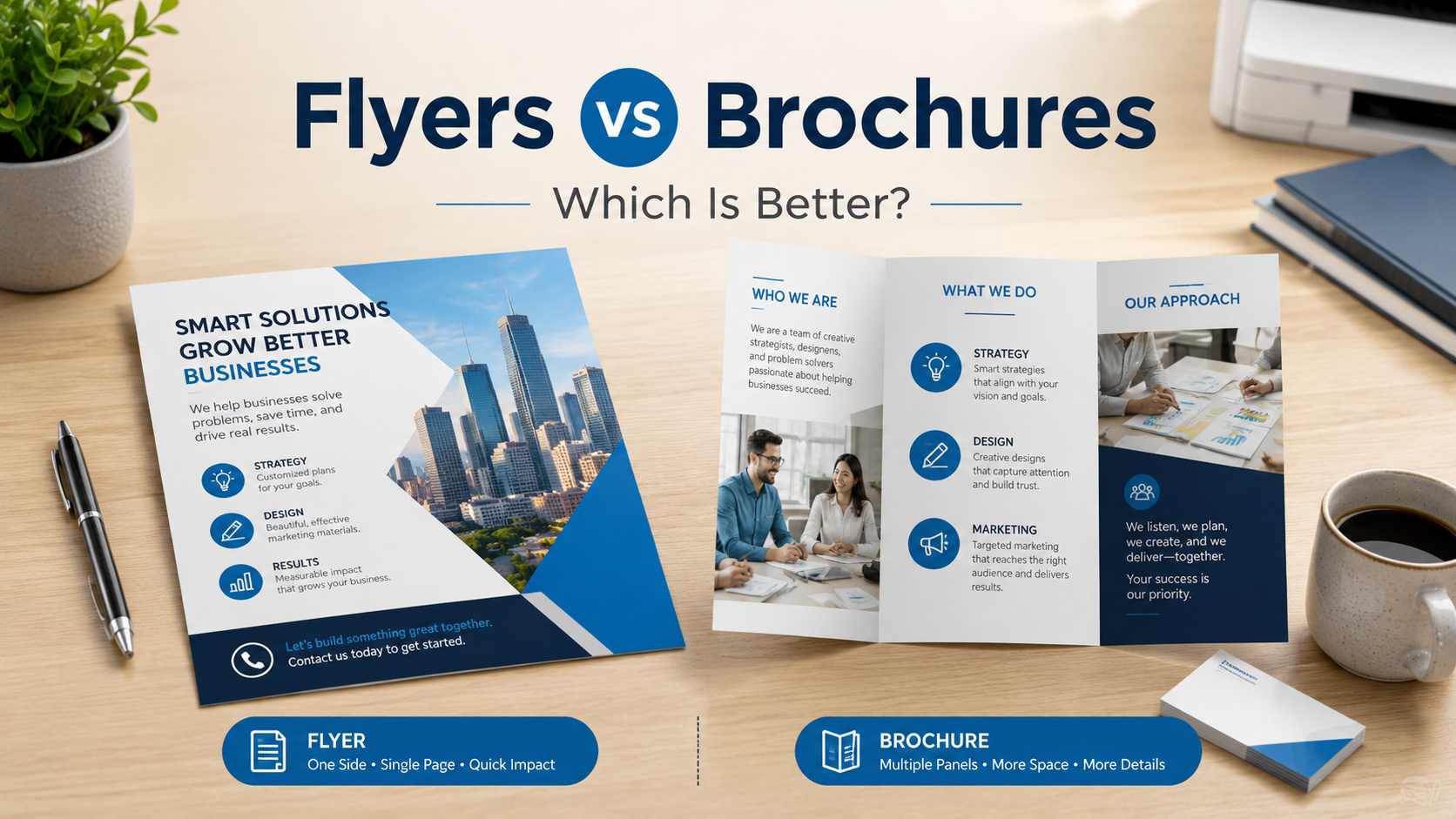
Flyers and brochures are both useful printed marketing materials, but they solve different problems.
- Choose a flyer when you need to promote one offer, event, announcement, menu, or action quickly.
- Choose a brochure when you need more room to explain several services, products, steps, packages, or features.
- Flyers are usually easier and less expensive to distribute in large quantities.
- Brochures provide a more structured presentation and often feel more substantial.
- A flyer should be easy to understand in a few seconds.
- A brochure can guide the reader through a longer sales or informational message.
The better format is not the one with more space. It is the one that gives the reader the right amount of information for the decision they need to make.
A flyer can be read while someone walks past a counter. A brochure is more likely to be picked up, opened, and reviewed panel by panel.
That difference shapes nearly everything about flyers vs brochures, including the design, amount of copy, printing cost, distribution method, and type of call to action.
For a one-day event, simple discount, or grand-opening announcement, a flyer is usually the stronger choice. For a service guide, restaurant menu, tourism handout, or company introduction, a brochure often gives you the structure you need.
What Is a Flyer?
A flyer is a flat, unfolded printed sheet used to communicate a focused message.
Flyers are commonly used for:
- Sales and promotions
- Grand openings
- Local events
- Concerts and performances
- Restaurant menus
- Service lists
- Product launches
- Classes and workshops
- Political or nonprofit outreach
- Package inserts
- Community announcements
- Real estate marketing
A good flyer usually has one primary job. It might ask the reader to attend an event, scan a QR code, book an appointment, visit a store, use a coupon, or learn about a new service.
CustomStickers.com offers custom flyers in several formats, including compact handout sizes and full 8.5-by-11-inch sheets. The flyers are printed in full color and have a matte finish by default, with other finishes available by request.
The format is simple, but that is part of its strength. A flyer can be handed out, placed on a counter, included in a package, posted on a community board, or distributed at an event without requiring the reader to unfold anything.
What Is a Brochure?
A brochure is a printed marketing or informational piece that uses folds to divide the content into panels.
The most familiar version is the tri-fold brochure. An 8.5-by-11-inch sheet is folded into thirds, creating six printable panels: three on the front side and three on the back.
Brochures are commonly used for:
- Company overviews
- Service descriptions
- Product guides
- Restaurant menus
- Price lists
- Tourism information
- Healthcare materials
- Real estate information
- School programs
- Event schedules
- Nonprofit outreach
- Welcome packets
- Instructions and educational materials
CustomStickers.com offers custom tri-fold brochures printed in full color on 8.5-by-11-inch stock. Current paper options include 14-point and 16-point material with a matte finish. The folded panels provide space for introductions, services, pricing, testimonials, maps, images, and contact details.
A brochure can still promote one main action, but it has enough room to answer the questions that may come before that action.
Flyers vs Brochures at a Glance
| Feature | Flyers | Brochures |
|---|---|---|
| Format | Flat, unfolded sheet | Folded into multiple panels |
| Best for | One focused message | Several connected sections |
| Reading time | A few seconds | Several minutes |
| Information capacity | Low to moderate | Moderate to high |
| Distribution | Bulk handouts, inserts, displays | Counters, packets, appointments, racks |
| Typical goal | Get immediate attention | Explain and persuade |
| Design structure | Headline-led | Panel-by-panel sequence |
| Production complexity | Simpler | Requires fold planning |
| Perceived presentation | Direct and practical | Organized and substantial |
| Best call to action | One clear next step | Next step after explanation |
The comparison becomes easier once you decide how much the customer needs to understand before taking action.
Choose a Flyer for One Main Message
Flyers work best when the entire message can be reduced to one clear idea.
Examples include:
- “Grand Opening Saturday”
- “20% Off This Weekend”
- “Now Offering Lawn Aeration”
- “Register for Summer Classes”
- “Live Music Friday at 7 p.m.”
- “Scan to View Our Takeout Menu”
- “Book a Free Estimate”
- “New Location Now Open”
The flyer can still include supporting details, but every element should reinforce the same action.
For example, an event flyer might include:
- Event name
- Date and time
- Location
- Short description
- Ticket price
- QR code
- Sponsor logos
That is enough information for the reader to understand the event and decide what to do next.
Problems begin when the flyer is also expected to explain the organization’s history, introduce every service, include five customer reviews, display a full menu, and answer every possible question. At that point, the business may need a brochure or a separate landing page.
Choose a Brochure When the Reader Needs More Context
Brochures are better when the customer needs to compare, understand, or review several pieces of information.
A home improvement company might use different brochure panels for:
- Company introduction
- Roofing services
- Siding services
- Window replacement
- Financing information
- Contact details
A veterinary clinic could use panels for:
- Preventive care
- Vaccinations
- Dental services
- Emergency policies
- Office hours
- Appointment booking
The fold creates a natural reading sequence. Each panel introduces one part of the message without forcing everything onto one flat page.
A brochure is particularly useful when an employee will discuss the information with the customer and then leave the printed piece behind. The customer can review it later, compare options, and share it with another decision-maker.
Flyers Usually Work Better for Time-Sensitive Promotions
A flyer is often the better format for information that will expire soon.
Examples include:
- Weekend sales
- Temporary coupons
- Holiday hours
- Event announcements
- Seasonal services
- Limited-time menu items
- Appointment openings
- Short enrollment periods
There is little reason to invest in a detailed folded piece when the information may be outdated in two weeks.
Flyers are lightweight, easy to distribute in large quantities, and suitable for promotions that need broad visibility. The current CustomStickers.com flyer line is specifically positioned for high-volume marketing, event handouts, local promotions, packaging inserts, and announcements.
Keep temporary flyers separate from evergreen company materials. That prevents a change in price or date from making an entire long-term brochure obsolete.
Brochures Are Better for Evergreen Information
A brochure makes more sense when most of the content will remain useful for months.
Good evergreen brochure topics include:
- Core services
- Company background
- Standard packages
- General product categories
- Visitor information
- Membership benefits
- Common treatment options
- School programs
- Venue information
- Care instructions
Prices and dates can change, so consider placing frequently updated information online. The brochure can include a QR code leading to the latest pricing, schedule, availability, or menu.
This keeps the printed piece useful without requiring a complete reprint every time one detail changes.
Which Format Is More Affordable?
Flyers are generally the more economical choice for large-scale distribution.
They use a flat format, require no folding, and are commonly printed on lighter material than brochures. That makes them practical when you need hundreds or thousands of handouts for an event, promotion, neighborhood campaign, or package insert. CustomStickers.com describes flyers as a cost-effective option intended for easy bulk distribution.
Brochures require more planning and finishing. A tri-fold brochure must be printed, trimmed, and folded correctly. The paper also needs enough body to hold the fold and feel intentional when opened.
But cost per piece is only one part of the decision.
A cheap flyer is not a good value when the reader needs more information before making a purchase. And a polished brochure wastes money when the message is simply, “Join us this Saturday.”
Choose the least expensive format that can do the job clearly.
Flyers Are Easier to Design, but Harder to Simplify
A flyer does not require fold panels, so the file is usually easier to set up. However, the limited space forces you to make stricter decisions.
A strong flyer normally includes:
- One clear headline
- One primary image or graphic
- A short supporting explanation
- Essential event or offer details
- Business name or logo
- One call to action
- Contact information or QR code
The headline should be understandable from a comfortable viewing distance. The supporting copy should be short enough to scan rather than study.
Avoid using several equally large headlines. The reader should immediately know which message comes first.
A flyer works poorly when every item is treated as equally important. If the logo, discount, date, address, phone number, photograph, and QR code are all competing at the same visual level, the result becomes difficult to scan.
Brochure Design Requires Careful Panel Planning
A brochure gives you more space, but the panels have to work in the correct order.
A common tri-fold brochure structure looks like this:
Front Cover
Use the front cover for:
- Business name
- Main headline
- Strong image
- Short value statement
The front cover should give the reader a reason to open the brochure.
Inside Panels
Use the inside panels for the main content:
- Services
- Products
- Features
- Benefits
- Process
- Packages
- Photos
- Testimonials
- Supporting explanations
The panels should follow a logical sequence. Do not make the reader jump between unrelated sections to understand the offer.
Back Panel
The back panel commonly includes:
- Contact information
- Website
- Address
- Social media
- QR code
- Hours
- Map or directions
- Final call to action
Before submitting a brochure file, print a basic paper mockup and fold it by hand. Label each panel, unfold the sheet, and compare it with the digital layout. This simple step catches many panel-order mistakes.
Use Flyers for Fast Distribution
Flyers can be distributed through:
- Store counters
- Checkout bags
- Customer packages
- Community boards
- Event tables
- Trade shows
- Street teams
- Schools and campuses
- Door-to-door outreach where permitted
- Partner businesses
- Waiting rooms
- Welcome packets
The distribution plan should be decided before the flyer is designed.
A 4-by-6-inch handout may fit easily into packages or shopping bags. A larger 8.5-by-11-inch flyer may work better on a bulletin board or as a detailed information sheet.
The current CustomStickers.com flyer options include 4-by-6-inch, 5-by-7-inch, 5.5-by-8.5-inch, and 8.5-by-11-inch formats, along with additional custom sizes available through support.
Do not automatically choose the largest size. A compact flyer may be easier for customers to keep, while a larger flyer offers more visibility and room for information.
Use Brochures Where People Have Time to Read
Brochures perform best in settings where the customer expects to review information.
Useful brochure placements include:
- Reception desks
- Hotel lobbies
- Tourism centers
- Medical offices
- Sales appointments
- Trade show booths
- Restaurant counters
- Real estate open houses
- School offices
- Visitor centers
- Welcome folders
- Community resource racks
A brochure holder can keep the folded pieces visible and organized. The front cover should remain clear enough to identify the topic without requiring the customer to pick it up first.
Brochures can also be included in proposals, estimate folders, new-customer packets, and product shipments.
Which Is Better for Direct Mail?
Either format may be mailed, but the mailing plan must be considered before the print file is finalized.
A flat flyer may need to meet specific size, thickness, addressing, and postal requirements. A folded brochure may need sealing tabs, an envelope, or another mailing format depending on its construction.
For Every Door Direct Mail campaigns, USPS provides an online size checker and requires mailpieces to meet its current flat-mail dimensions and weight rules. Confirm eligibility before printing rather than trying to adapt an already finished piece.
Also consider what happens when the piece arrives.
A flyer or oversized flat piece may create faster visual impact. A brochure can carry more information, but the recipient must choose to open it. For a simple local offer, a flyer or postcard-style piece may be enough. For a higher-value service that requires explanation, a brochure in an envelope may be more appropriate.
Which Is Better for Restaurants?
The answer depends on the menu.
A flyer works well for:
- Short takeout menus
- Lunch specials
- Grand-opening offers
- Catering promotions
- QR codes linked to an online menu
- Seasonal items
- Delivery inserts
- Coupons
A tri-fold brochure works better for:
- Full restaurant menus
- Catering packages
- Several food categories
- Large drink selections
- Banquet information
- Private event options
- Restaurant history and location details
Avoid printing information that changes every week unless you are prepared to replace the material regularly.
A QR code can connect either format to current prices, online ordering, reservations, or dietary details.
Which Is Better for Service Businesses?
A flyer is usually better when promoting one service.
For example:
- Spring sprinkler startup
- Free roof inspection
- New-patient dental exam
- Seasonal furnace tune-up
- Wedding photography mini sessions
- Tax preparation appointments
A brochure is better when introducing an entire service company.
A landscaping brochure might explain lawn care, irrigation, hardscaping, seasonal cleanup, and maintenance plans. A flyer would be more suitable for promoting one spring cleanup offer.
Many service businesses benefit from using both. The brochure explains the company. The flyer supports a specific seasonal campaign.
Which Is Better for Trade Shows and Events?
Use flyers when you expect to distribute a large number of pieces quickly.
A flyer can:
- Announce a show special
- Promote a demonstration
- Share a schedule
- Direct people to a booth
- Provide a discount code
- Send visitors to a landing page
Use brochures when the visitor needs something more detailed to review after the event.
A brochure can:
- Explain your services
- Compare product lines
- Outline a process
- Introduce several packages
- Show case studies
- Answer common questions
A useful trade show combination is a brochure paired with a smaller branded item. For example, a business can give qualified prospects a brochure and include custom stickers as a package insert or giveaway.
The brochure carries the detailed information. The sticker provides a longer-lasting reminder of the brand.
When Should You Use Both?
Flyers and brochures do not have to compete.
A business might use:
- A brochure for its standard service overview
- Flyers for monthly promotions
- A brochure in new-customer packets
- Flyers at large public events
- A brochure for sales appointments
- Flyers as order inserts
- A brochure for wholesale buyers
- Flyers for holiday offers
The brochure serves as the stable foundation. Flyers support messages that change more frequently.
This approach prevents the main brochure from becoming crowded with every temporary promotion. It also allows the business to replace short-term materials without redesigning its complete company overview.
Common Flyer Mistakes
Including Too Much Information
A flyer should not attempt to become a brochure in miniature.
Using a Weak Headline
“Welcome to Our Flyer” does not tell the reader why the message matters.
Hiding the Call to Action
The reader should know whether to call, visit, scan, register, or purchase.
Using Small Text
A flyer must remain readable in the setting where it will be distributed.
Forgetting the Distribution Plan
The size, layout, and paper should fit how the flyer will be handed out or displayed.
Skipping Bleed and Safe Margins
Background artwork should extend beyond the trim line, while important text should stay safely inside it. Full-bleed printing requires the artwork to extend past the final cut so the printed background reaches the finished edge.
Common Brochure Mistakes
Putting Panels in the Wrong Order
Always create and fold a paper mockup before submitting the file.
Overloading Every Panel
White space helps readers understand where one section ends and another begins.
Using the Cover as a Summary Page
The cover should create interest. Save detailed explanations for the inside.
Making the Brochure Too General
A brochure still needs a clear audience and purpose.
Using Outdated Information
Move frequently changing prices, schedules, and inventory details to a webpage when possible.
Forgetting the Fold
Avoid placing important text, faces, QR codes, or small graphics directly across a fold line.
How to Decide Between Flyers and Brochures
Ask these questions before choosing a format:
- How many ideas do I need to communicate?
- How much does the customer already know?
- Does the information expire?
- Where will the piece be distributed?
- How long will the reader have to review it?
- Does the customer need to compare several options?
- Is this for broad awareness or a qualified lead?
- What action should the reader take?
- How many copies do I need?
- Will the piece be mailed?
Choose a flyer when the message is narrow, immediate, and easy to scan.
Choose a brochure when the customer needs explanation, organization, and enough detail to make a considered decision.
Final Thoughts
Flyers vs brochures is not really a question of which printed product is better. It is a question of how much information the customer needs.
A flyer is usually better for one focused message, broad distribution, short-term promotions, and immediate action. It gets attention quickly and can be printed economically in large quantities.
A brochure is better when the customer needs several sections of information before making a decision. The folded panels create a clearer path through services, products, packages, or instructions.
Start with the purpose. Decide what the reader needs to know, where the piece will be used, and what should happen next.
Then choose the simplest format that communicates the message without feeling incomplete or crowded.